
Why Horror Over Love?
In Films and in Real Life

In the late 1980s, Mark and I drove up to Los Angeles with a couple of scripts under our arms and hope riding quietly in the backseat. We headed to Paramount Studios in Studio City to pitch love stories. Not romance for romance’s sake, but stories about connection, courage, intimacy, and what binds people together over time.
The meeting was cordial. Businesslike. And short.
They were focusing on horror.
We left the studio lot understanding exactly what that meant. Our stories were not wrong. They just did not fit the appetite of the moment.
A few years later, in 1994, history repeated itself in a different form. Discovery Channel initially expressed interest in our completed documentary Full Cycle: A World Odyssey. It was a global journey fueled by adventure, human endurance, and shared trust. A love story, really. Not just between Mark and me, but between people, cultures, landscapes around the world and the sport of mountain biking.
Then came the reversal.
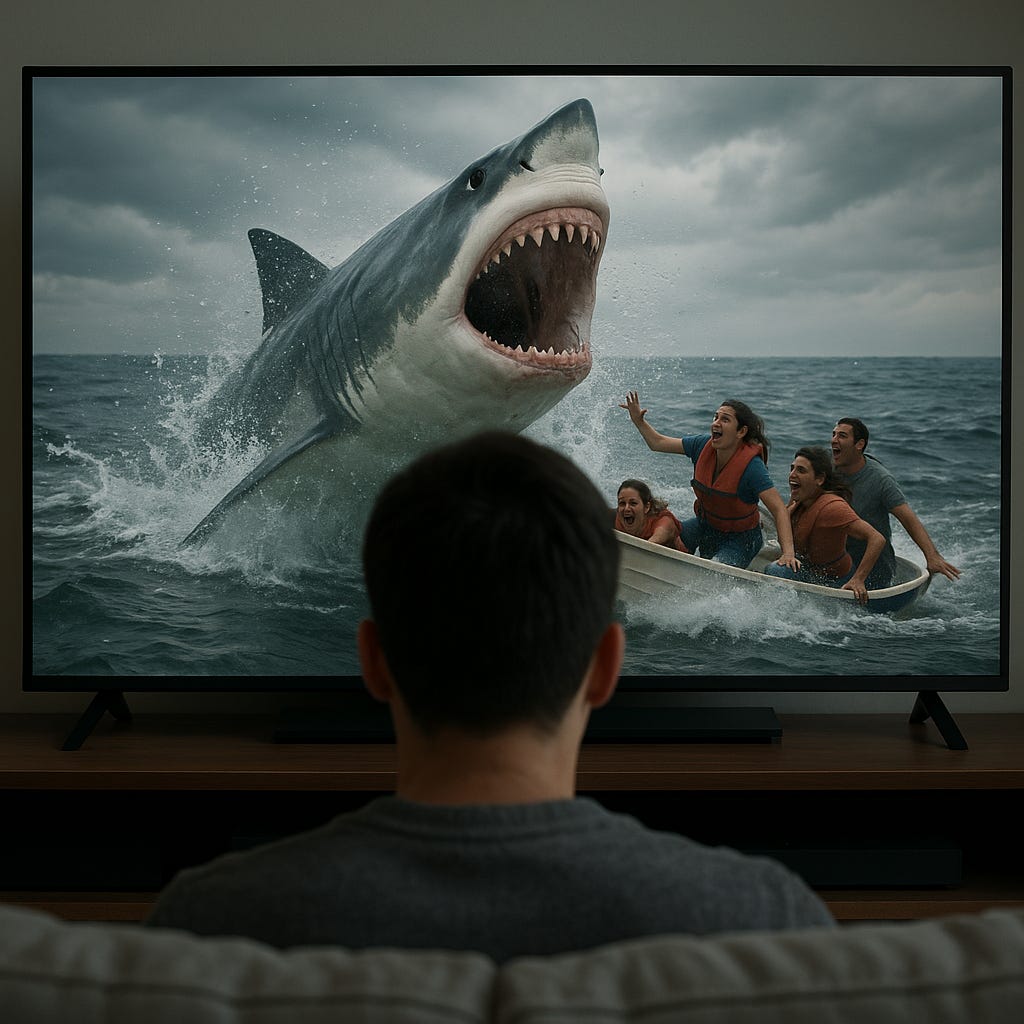
Discovery told us they were recalibrating their programming priorities. The focus had shifted. Shark Week. Fear-based spectacle. Threat and danger as entertainment. Once again, love and wonder quietly slipped out of frame.
At the time, we moved on. Independent creators have to “keep on swimming or sink.” And now, decades later, the pattern feels impossible to ignore.
Why does horror outperform love?
Fear acts fast. It jolts the nervous system. It captures attention instantly. Horror lets viewers experience danger without obligation. Scream, recoil, switch it off, continue on unchanged. Love requires something deeper. It asks for presence. Vulnerability. Emotional work. Love asks us to abe present.
Horror keeps danger external. The monster is out there. The villain is other. A shark. A threat. Something that can be destroyed or outrun. Love stories turn the lens inward. The struggle is miscommunication, fear of loss, pride, time, aging, forgiveness. These are not easily resolved or neatly packaged.
So fear became marketable.
And over time, it became dominant.
Today, the reflection shows up everywhere. We scroll through outrage. We binge catastrophe. We rehearse collapse as entertainment. Meanwhile, love stories are dismissed as soft, sentimental, or unrealistic.
Yet look around.
We inhabit a world saturated with anxiety and division, yet starved for connection. Trained to anticipate danger, but unsure how to sustain kindness. Prepared for disaster, but unpracticed in empathy.
Perhaps people do not avoid love stories because they lack interest.
Perhaps they have simply been trained to distrust them.
Love stories remind us of responsibility. Of listening. Of remaining open when retreat would be easier. Horror lets us project fear outward. Love insists we face it within.
Mark and I keep choosing love anyway.
We keep telling those stories. In films. In music. In the life we have built together. Not because they are the easiest stories to sell, but because they are the most necessary ones to live.
So I’ll ask the question that has followed us since the late 1980s, from studio lots to cable networks to the culture we now inhabit:
If fear is what we continually reward in our storytelling, what kind of world are we training ourselves to expect?
And perhaps more importantly:
What might change if we dared to put love back at the center again?
As I finish this piece, the weekend news is saturated with real-world horror. Not fictional monsters, not sharks on a screen, but human violence erupting in homes, public places, and institutions meant to feel safe. One detail has stayed with me in particular: that Rob Reiner, whose body of work helped define modern love stories, humor, friendship, and human connection, is now being spoken of in the same breath as unspeakable tragedy. Reiner gave the culture When Harry Met Sally, The Princess Bride, stories that insisted love, loyalty, and wit mattered. And yet even those who have devoted their lives to telling stories of connection are not insulated from a world increasingly shaped by fear, untreated illness, isolation, and rupture. It makes the question feel unavoidable. When we elevate horror as entertainment and sideline love as unserious, what are we practicing emotionally, culturally, collectively? I do not believe love stories are escapism. I believe they are training grounds. They teach us how to recognize one another as human, how to stay soft without being naïve. And perhaps now more than ever, choosing to tell them is not indulgent, but essential.
I so agree with you Patty. With so much real life horror as well as fictional horror our only coping mechanism is desensitization. We have to block it out, become immune - just to survive the ongoing bombardment. Why not share stories of love or positivity rather than share something horrific you’re outraged by? I’d like to see a lot more ‘look at this, look how good it is’!
Well said