
Strings, Circuits, and the AI Slop Conversation
On the Topic of Music

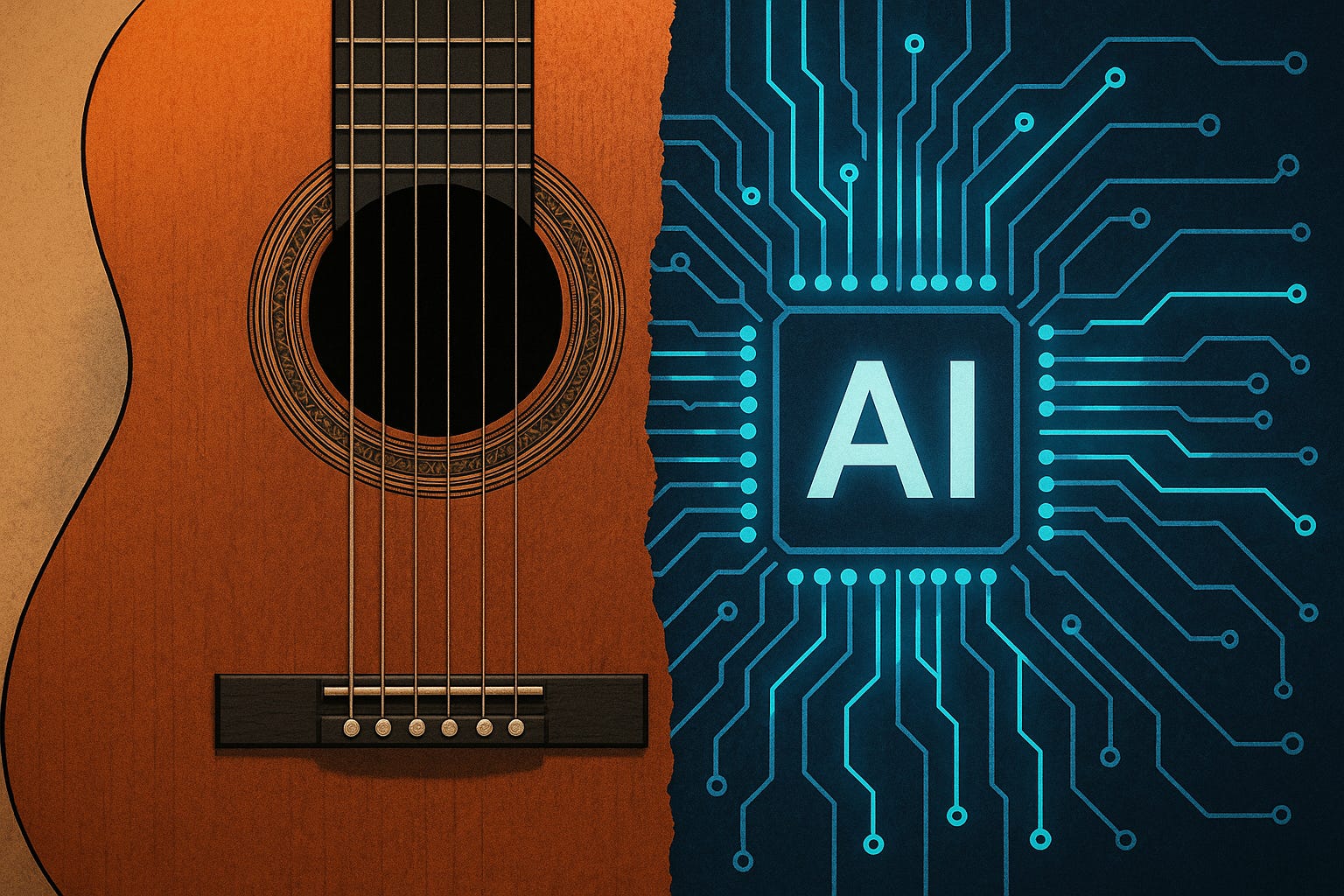
There’s a lot of noise right now around music and AI. Raised voices, pointed fingers, lawsuits flying, words like theft, soulless, lazy. Increasingly, one phrase gets hurled like a brick: AI slop. It is the shorthand many traditional musicians use to dismiss music made with tools like Suno and Udio. The conversation itself has begun to resemble what it condemns, flattened, overheated, contemptuous. On one side stand musicians who have spent lifetimes learning their instruments. On the other, people creating music through prompts, code, and curiosity.
And somewhere in the middle sits me.
I’m not new to tools. I’m not new to art. And I’m not new to waiting.
Why “AI slop” lands and also misses
I understand where the anger comes from. Truly. There are real harms here. Platforms flooding the zone. Algorithms rewarding volume instead of care. Unresolved questions about whether human-made music was used without consent to train machines.
That injury deserves attention and remedy.
But I’ve also noticed something quieter and more troubling beneath the rhetoric. It sometimes sounds as if the objection is not only to how AI music is made, but to the fact that people are enjoying themselves.
There is a palpable resentment toward delight, toward experimentation, toward ordinary people discovering they can make something musical and feel proud of it.
That reaction isn’t really about copyright.
It is about control.
When joy shows up without permission, it tends to be called slop.
The long wait
I’ve been writing poems since I was a teenager, more than 55 years of words, journals, notebooks, and drafts. For most of that time, I believed my poems would eventually become songs through the traditional route. A musician hears something in the writing and wants to collaborate.
For the last five years especially, I waited.
I shared my poems openly. I hoped. I was patient.
It happened once.
One musician said yes. One poem crossed the bridge into music the old way. It was affirming and brief.
It was a short-lived delight.
And that history matters. My decision to use AI tools did not come from impatience or shortcut-seeking. It came after decades of believing in collaboration and after years of realizing that waiting indefinitely was its own kind of silence. And knowing I have less time ahead of me than behind me.
Candace Love is not a button push
One of the laziest critiques of AI music is the myth that it is just pushing a button.
Anyone who has actually tried to make a coherent body of work using tools like Udio knows that is untrue.
As Gemini 3 on Reddit wrote in a widely shared post:
“Anyone who has actually tried to make a coherent, four-track concept EP on Udio knows that is false. If you just push the button, you get a mess. To get Track 1 to flow into Track 4 conceptually and sonically requires a human ear.”
That resonates deeply with my own experience.

Candace Love songs are not accidents. They require decisions about lyrics, phrasing, structure, genre, tone, pacing, what to keep, what to reject, and when a song feels finished.
The AI generates options.
I exercise judgment.
I studied poetry for many years at the feet of master poets to include the world’s greatest living poet, Carolyn Forche, and those who have passed: Galway Kinnell, Steve Kowit, LoVerne Brown and others. The joy of setting my poems to music - whether anyone else ever hears them or not, whether I make money or not, and whether I incorporated actual instruments versus digital ones - is incomparable. We should all live so long as to achieve our long-harbored dreams.
The Rick Rubin paradox
There is an irony here that’s hard to ignore.
Rick Rubin is one of the most celebrated producers in music history. He is known for not touching instruments or mixing boards. He listens. He guides. He says things like, “That part isn’t working,” or “Do it again, but slower.”
He receives credit. Grammys. Copyright participation.
As Gemini 3 on Reddit also observed:
“You essentially did the exact same thing with Udio. You rejected the bad takes, you guided the musicians, the AI model, and you structured the final product. The law currently rewards execution when a human plays the guitar but ignores direction when the musician is a machine.”
That is the paradox we are living in.
Direction is recognized as artistry right up until the session musician happens to be synthetic.
We’ve been here before
When photography was invented, painters insisted it could not be art because the machine did the work.
Eventually, the law recognized what artists already knew. The choices of subject, framing, lighting, and timing were the art.
We are in the early photography phase of AI music.
Right now, people see the machine.
Eventually, they will have to see the human intent behind it.
Where I stand
I do not believe AI will replace musicians.
I do believe it has changed who gets to participate.
Candace Love is my answer to a 55-year wait. Not a provocation. Not a bypass. And certainly not slop.
A woman with decades of words finally finding instruments.
If the future of music has room for intention, provenance, and lived experience, then there is room for artists like me.
And one more thing feels worth saying plainly.
Music is a gift for all humans.
Not just the trained.
Not just the young.
Not just those who entered through corporate-sanctioned doors.
A gift meant to be explored, shared, reshaped, and enjoyed.
And when people find happiness through making music, by hand, by wire, by circuit, maybe the most human response is not contempt.
Maybe it is listening.
Patty, this is a great comparison example of how technology has changed our past and will effect our future.
I’m glad that you have this outlet that brings you joy.