
Dissection, Fig Trees, and What We Choose to Keep Whole
Upon the Death of Renee Good

After reading Renee Nicole Good’s poem, I went looking for others who had felt its force the way I did. I found myself on a Reddit thread devoted to discussing her work. What struck me immediately was not insight or curiosity, but hostility. The thread was pocked with anti-intellectual interlopers who seemed less interested in the poem than in picking a fight. Mockery. Dismissal. A reflexive contempt for poetry itself.
It made me wonder, not for the first time, why there is such disdain for poets and poetry in certain corners of our culture. Why careful language is treated as suspect. Why metaphor is dismissed as indulgence. Poetry asks us to slow down, to feel, to tolerate ambiguity. For some people, that seems intolerable - especially when the poetry is by a woman.
Perhaps that is why Renee’s poem matters so much right now.
Her award-winning poem about dissecting a fetal pig is not really about biology. It is about the moment when reverence gives way to procedure. When something once alive becomes an object. When distance replaces empathy. I read it three times. Three readings is a good way to truly digest a poem. The first time for sound and shock. The second for structure. The third for meaning that seeps in quietly.
By the third reading, I was struck by how prescient it felt.
I should pause here to say something plainly. I have been sending my poems to contests for decades. Regional contests, national contests, small ones, ambitious ones. I have never won a prize as prestigious as the one Renee Good won for that poem. Anyone who has spent years submitting work understands what an accomplishment that is. It represents not just talent, but persistence, courage, and a willingness to keep offering your interior life up for judgment. That kind of recognition does not happen by accident.
Renee wrote about a fetal pig as a symbol of something brutalized, stripped of dignity, reduced to parts. And now, in an unbearable irony that only real life can produce, reports say she was killed by a man identified as Jonathan Ross, who shot her in the face and left her disfigured, punctuating the act with a final curse. The cruelty of that detail is hard to metabolize. It feels obscene to even write it down. And yet, it belongs to the truth of what happened.
What haunts me is not just the violence, but the echo. The way her poem seems to reach forward in time, warning us about what happens when we lose our sense of the sacred. When life becomes something to dominate rather than protect.
Around the same time, I began reading The Island of Missing Trees by Elif Shafak. I am only a few chapters in, but already it has taken hold of me. The idea that trees have memory, feelings, and sentience does not strike me as fanciful. It feels intuitive.
When Mark and I first saw the house we live in now, we were up against eleven other bidders. The market was tight and unforgiving. But when I walked into the backyard and saw a trio of fig trees - Mission figs and green ones - something in me shifted. I made a silent entreaty to them. Help us make this home ours.
We did. We have lived here for twenty-six years.
Our backyard faces a mountain where hikers go up and down all day and even at night, when their head lamps glow like a string of lustrous pearls along the ridges in the darkness.
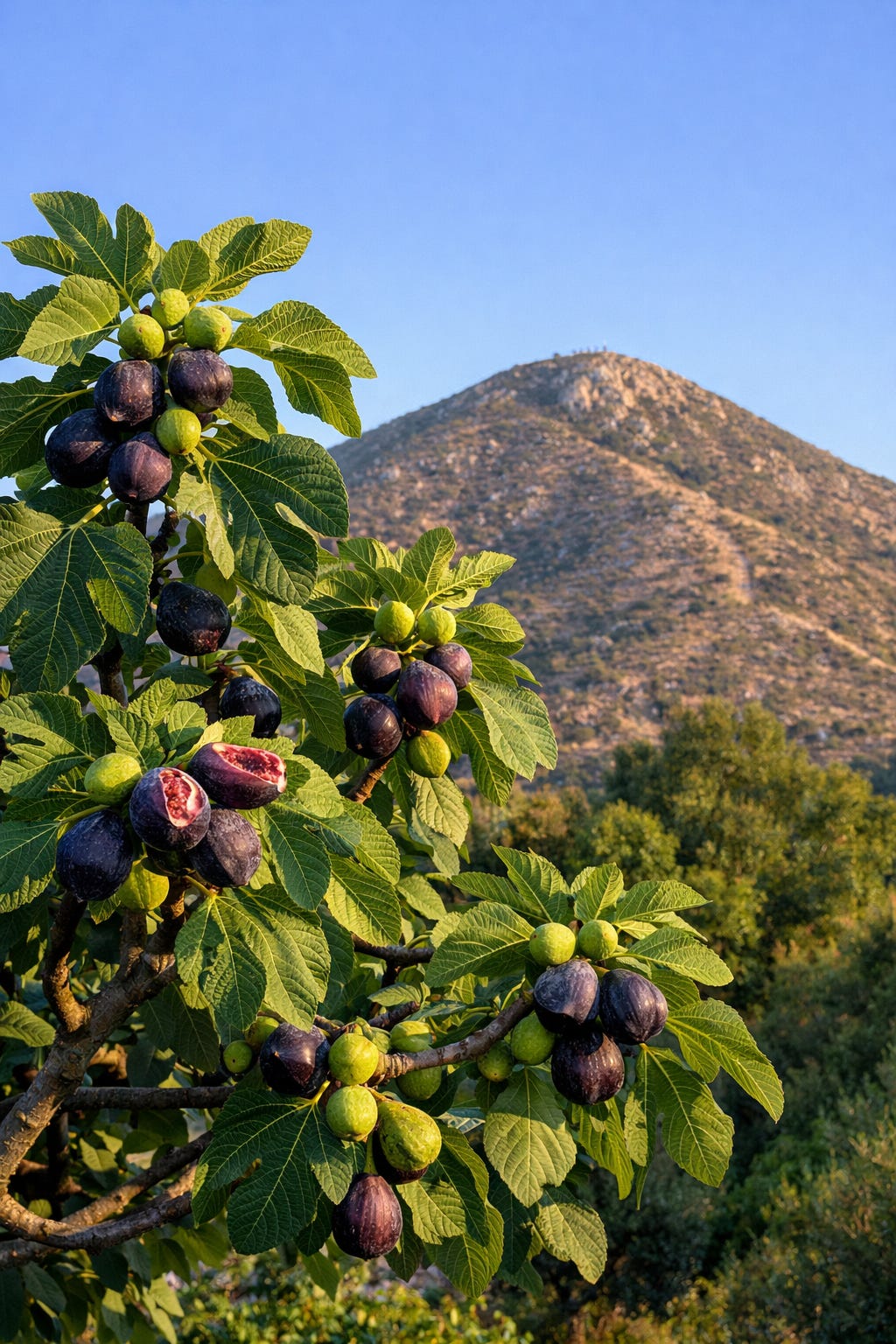
Every year, when the fig trees burst with fruit, I give thanks. Mark is the green thumb, the one who waters faithfully, who tends and watches and knows when to intervene and when to leave things alone. Each fig feels like a gift directly from Mother Nature.
I still speak with the trees, especially when I am out there pulling that relentless asparagus grass, wrestling it from the soil inch by inch. I have written a poem about those fig trees. Parts of it come back to me now, especially as I think about Renee and the world she was trying to name.
“The first figs of the season were offered to Bacchus,
and at festivals in his honor,
devout females wore garlands of dried figs.”
There is something ancient and devotional about figs. Something that predates our modern urge to quantify and dissect.
“The Prophet Mohammed once exclaimed:
‘If I should wish a fruit brought to Paradise
it would certainly be the fig.’”
Even Cleopatra understood their symbolism.
“The fig was Cleopatra’s favorite fruit
with the asp that ended her life
brought to her in a basket of figs.”
Figs carry sensuality, nourishment, danger, sweetness, and power all at once. They resist simplification.
“And the yield of a man?
Luscious figs.
Note the shape, the heft, the texture.
No other object so perfectly approximates.”
Figs are whole. They are not meant to be reduced to parts. They are meant to be tasted, held, appreciated in season. Some of our favorite social moments include a platter of halved figs with goat cheese. Delectable.
“For a season those fig trees bow
to me with their bounty:
Calimyrna,
Mission,
Kadota.”
When I read Renee’s poem, I felt that same insistence on wholeness. Her work resists flattening. It refuses to let us look away from what is lost when curiosity becomes cruelty.
The hostility I saw on that Reddit thread felt like another kind of dissection. A desire to tear poetry down, to strip it of meaning, to declare it useless. “Consider the source,” my mom used to tell me consolingly whenever I was bullied as a young teen.
Poetry survives because it insists on interior life. It insists on relationship. On curiosity.
Trees. Poems. People.
We live in a time that rewards speed, outrage, and dominance, and yes, misogyny. Poetry asks something else of us. It asks us to notice. To pause. To keep some things intact.
Renee did that with her words. Even now, even after everything, her poem stands as an act of prescience, of witness, of a candle snuffed out too soon.
I have written many poems.. perhaps more than I have read or heard. but it neever seems to be enough
it could be verse
think of all the people
who never receive
or read a poem
who never write
a poem and free
the words in their
soul
and put that thought down
in an envelope to mail away
and live